
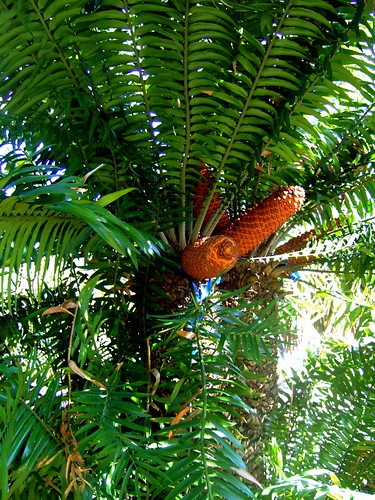
 Encephalartos gratus Zamiaceae, female, collected from Malawi, on the property of the Center for Tropical Plant Research. Cycads are really fascinating ancient plants, related to conifers.
On Friday morning, my spirit shifted into a beautiful place by the simple observation of plants and the tenaciousness of life.
Surrounded by cycads, the world’s most ancient plants, right here, practically in my own back yard, was the incredible feeling of “I am complete somehow.” I could taste the salt air of Biscayne Bay on my skin and the fact that the predecessors of these plants had been around for millions of years.
Can you imagine breathing in that incredible air? Filling your lungs not only with oxygen but some living poetry? We have it down here, in Florida for sure – ancient creatures, like crocodiles and cycads. Once you tune into that cycle of nature, the breathing of the tides in the bay, the musky scent of mangroves in low tide, the lilac sunsets -- you have a real, primeval Florida that can inspire you beyond that concrete jungle and expressway tangle.
And which makes me think, this is no shallow place at all, but a place so deep -- even though you can barely dig 15 feet beneath the limestone to find water – but in spite of that you can dig and dig and never really find that treasure of El Dorado.
For me treasure is not gold, but love. And I guess plants bring me closer to this pure energy, more than anything else ever has -- total unconditional love -- love that is just present and beyond the ego.
Maybe we are all in our own little ways a little bit like Ponce de Leon looking in Florida for some fountain of youth, but maybe we should be looking for a fountain of love.
These cycads are not native to South Florida. They came here as the result of exploration and planted at the behest of Colonel Montgomery, the founder of Fairchild. Exploration is at the bottom of all this -- Fairchild was the Indiana Jones of tropical plants. Now, I can't say for sure which plant is attributed to whom-- but this is besides the point, the point is -- someone went somewhere to bring it here -- and this is precisely the spirit of tropical plant conservation that is still going on today. This passion for the plants, this passion to conserve them from extinction in our crazy world today, is the driving force behind all of this.
But let's forget the historical romance ... let me get back to my moment. Today, these cycads are thriving locally. They have not only made a century’s old journey across continents but also a genetic journey of a million years or more … is that not amazing?
And what's more, why can’t people make the same journey – together?
If I describe what I felt last Friday morning, surrounded by these ancient trees in the chill air of a cold front – I would call it pure and simple love – a love based on compassion. Being surrounded by these ancient trees brought out something in me that compelled me to an analogy, a bigger picture, something beyond me yet part of me: we are so much like plants, going through our cycles, flowering, withering and renewing.
Was it not some kind of love that planted these things in the first place?
And the most moving thing of all among these Jurassic plants was the sense of community … none of them exist in a vacuum. We depend on each other, like it or not, to thrive. We need the same soil, the same pollinators, to survive. Actually, this is a good metaphor for social media – the garden.
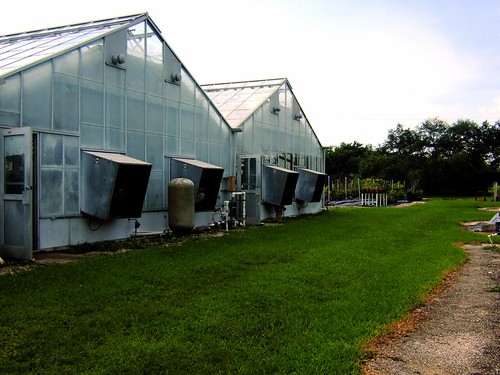
So it was with no surprise that while volunteering back at the nursery -- a greenhouse technologically designed to imitate the environment of a rain forest -- we found a corn snake while repotting a pineapple.
I knew then that this was a kind of Garden of Eden for me, among the slippery mud and muck of the floor, among the humidity, sweat and dirt-soaked fingers of my hands, I had found my own little paradise.
 Oops! This corn snake really didn't want to leave its nice warm, humid pot. You think it's hot and humid in Florida? Those special plants inside the nursery need even more heat and humidty!
FYI ... (sorry, this is the fact-checking journalist in me) Montgomery Botanical Center is located right behind the Center for Tropical Plant Conservation neither of which are open to the public. Mind you, I get to go as a volunteer. As far as I know, both institutions are not currently legally/technically related, though historically it was Colonel Montgomery who founded Fairchild. I know I said I would take a break from writing, and I have ... much catching up to do. But I was so inspired by this moment that I could not help but share and hope it will inspire readers to go to Fairchild, because it is truly something so unique to South Florida and related to the rest of the tropical plant world across the globe.



 Posts


