April 20, 2009

Dragonfruit


A Bee's Eye View # 1, originally uploaded by vicequeenmaria.

I fractured my fibula from a fall, so basically I will be on crutches for about eight weeks. No volunteering for me! Rest assured, I'll be back at the garden as soon as my ankle heals, though you may find me there in a wheelchair from time to time -- Fairchild has 20 of them at admissions for those who are unable to walk. I can't imagine going eight weeks without seeing this beautiful garden.

In the meantime, I leave you with a picture of a spectacular dragonfruit flower, in one of its many metamorphoses.

March 18, 2009

Volunteer Appreciation Brunch 2009

volunteer brunch at fairchild
On Wednesday, March 18, I attended my first Volunteer Appreciation Brunch at Fairchild. The Garden House was packed with over 100 volunteers and many more staff. Food was provided by staff -- their chance to do something for us -- featuring lots of delicious homemade platters, salads and desserts.

Sculptor Mark di Suvero, who is one of the featured artists this season, stopped by to say hello. Apparently, he made a special trip just to see us volunteers.

Last year, over 500 volunteers dedicated 67,000 hours of work to the garden. Board of Trustees director Bruce Greer said in no uncertain terms that the organization would not be able to survive without us. He also told us about how they've managed to stay afloat in these economic uncertain times by being fiscally conservative. While other non-profits are struggling, Fairchild is doing relatively well.

He also talked about the new scientific research facility to be built near the Garden Cafe. This is exciting because the laboratories will be in full view of the public and the scientists will give brief talks to kids everyday. The hope is that more kids will be inspired to study plants or become scientists instead of investment bankers. (I'm paraphrasing, but that's what he said, and as you can well imagine, it got a good laugh from the house.) By the way, Fairchild's education program serves over 50,000 school kids a year.

Pins were given to volunteers who were celebrating 30, 25, 20, 15, 10 and 5 years in the garden. Yes, some people have been volunteering for 30 years! That's a career for some. Most of the volunteers I have met are retired folk, but that doesn't mean there aren't younger, working professionals like myself getting involved.

On a personal note, I bumped into my junior and high school French teachers, whom I hadn't seen in over 20 years! I had no idea they were involved. They are devoted to the education program.

I cannot emphasize how rewarding it is to volunteer for this organization. Five-hundred plus people who have devoted years -- if not decades -- to volunteering can't be wrong.

Orchid Festival 2009

orchid festival fairchildA spectacular, cascading dendrobrium.

Unfortunately, something went wrong with my "good" camera and so I only have a couple of crappy photos from my mobile phone. But let me tell you -- the Orchid Festival at Fairchild, as always, was a feast for the eyes. Dozens upon dozens of vendors, lined up on the westernmost stretch of the garden, were selling blooms as small as a dime or as big as a dinner plate.

The real treat was the orchid exhibit indoors at the Garden House. Imagine an Oscars ceremony with the A-list stars showing off their hot bods, gowns and baubles on the red carpet. Well, at the festival, these prize-winning blooms stole the show. My friend commented that the orchids were so gorgeous, they almost didn't look real! And it was true -- festooned with their award ribbons, these orchids would've have upstaged even the biggest Hollywood diva.

orchid festival fairchildA prize-winning cattleya.

There's a reason for all this pageantry, of course, and it's all in the name of sex. Each orchid is especially adapted to attract particular pollinators according to shape, scent and color. The variety is daunting. From tiny to titanic, unassuming to gaudy -- each orchid seems to have its own personality for the sake of adaptation.

The festival is a wonderful way to introduce yourself to the world of orchids, even if you have no experience growing them. Fairchild offered classes all day Saturday and vendors were eagerly answering questions.

I'll paraphrase what's said in one my orchid books -- they aren't impossible to grow, and as a matter of fact, can be downright easy, compared to other plants. There's no need to be intimidated. You can, however, make the whole process as complicated as you like.

On the one hand, there are amazing orchids growing off trees with little, if any, human involvement whatsoever. They live off the air and when not in bloom, they look like plain leaves or dead twigs. For example, here's an enormous one that blooms yearly in South Miami:

This orchid blooms in someone's yard every year in a low-maintenance manner. Near the intersection of SW 80th street and 57th avenue.

On the other hand, if you're a hardcore enthusiast, you can spend every day of your life caring for your orchids, working with exotic varieties and hybrids, attending orchid society meetings, reading books and so on. For some, it's a full-time hobby.

Either way, novice or professional, you can enjoy growing orchids here in South Florida as we are blessed with optimal weather patterns and specific pollinators for certain kinds of orchids. They don't bloom as often as other flowering plants but when they do, it's a special treat. To get started, visit the South Florida Orchid Society and the American Orchid Society, which has a great beginner's FAQ.

The festival wasn't all about orchids. Musicians played on the main lawn, food vendors served up some great options -- including traditional Bahamian and Jamaican fare. There were also plenty of activities for kids.

I had volunteered all day Saturday at the fruit pavilion, cleaning up leaves, making smoothies, assisting with fruit tastings and talking to people about the garden. We were quite busy so I barely got to see any orchids on that day!

It was a great pleasure to attend as a "visitor" on Sunday with a friend who hadn't been to the garden in 20 years. Steve Roitstein of PALO! is not only a great musician but also an avid gardener. He got to take a "Maria" tour, which we finished off at Matheson Hammock Park, enjoying the bay breezes and great view of the Miami skyline just before sunset.

Thankfully, I was able to get a video on Qik of the prize-winning orchids, but use your imagination. My camera can barely do these beauties any justice!

March 16, 2009

Exploring and Conserving: Fairchild Expedition Blog

Plant exploration in Jamaica. Photo at exploreplants.org


I recently learned that some Fairchild staff is keeping a blog about their plant exploration in the Cockpit Country of Jamaica at exploreplants.org. This is in true keeping with the spirit of David Fairchild, the great plant explorer and namesake of the garden, of course!

The Cockpit Country is known for its rock formation and challenging -- if not forbidding -- access. Historically, this place was home to the Maroons, a group of slaves that escaped into this mountain region and evaded capture. An island of biodiversity within an island, the area holds much promise for plant exploration.

Plant exploration and collecting of specimens is pretty hard work. When I interviewed Noris Ledesma, Fruit Curator at Williams Grove (now known as Fairchild Farm, by the way), she told me that it's non-stop collecting, documenting and traveling -- rather like an Indiana Jones approach but without any of the big screen glamor. You don't get a lot of sleep, that's for sure. It's no tropical vacation, especially when you have to deal with a long flight from Miami over to Asia. 24/7, all you care about is those tree grafting and seed specimens you need to conserve in order to make for viable growing and study here in our own backyard.

While Noris works with the fruit program, the staff in Jamaica has a similar goal. Melissa Abdo writes about a Saturday -- first the market, then getting the laundry off the clothesline before it rains and then ...
I managed to run some preliminary analyses while stuck indoors, and am thrilled to report that we have already collected, documented, and prepared at least 640 scientific plant specimens- in addition to numerous propagules already representing a healthy, robust horticultural collection. Astoundingly, our hard work has already yielded critically important collections of plants- including many endemics- and provided growing evidence of the importance of biodiversity conservation of Jamaica’s Cockpit Country.
When you visit Fairchild here in Miami, keep this in mind: nearly every plant you see is a result of some kind of exploration that aimed at conserving and studying the plant for a universal benefit. That plant didn't just get here on a first class plane ticket. A lot of work went into this amazing display of tropical flora. But it's not just about looks: botany affects us all -- from the first cup of coffee in the morning, to the natural fibers in our clothes, to the pills we take for illness.

This blog also features some exploration notes from the garden's expeditions in Palau, written by Dr. Carl Lewis, who is now Fairchild's new director.

Check it out!

March 12, 2009

Orchid Festival and Other News


Things have been a little quiet around here lately because I had to go on a hiatus. One of my parents had surgery and the other was sick. I've also not been to well and so have had to take it easy.

In addition, some management changes at Fairchild have put my work with the fruit program on hold, though I anticipate helping out on random special occasions or at Williams Grove on some weekends. I'll probably resume my consistent involvement with the fruit program around May as we prepare for the big mango festival in the summer.

In the meantime, I'll be working with the Keys Coastal Habitat, starting next week. It'll be a great opportunity to learn more about native vegetation and to support a wonderful conservation effort.

Don't miss this weekend's Orchid Festival! I'll be at the fruit pavilion on Saturday handing out fruit samples. Stop by and say hello.

January 29, 2009

Talipot Mania

talipot palm at FairchildTalipot Palm. Photo courtesy of Fairchild Tropical Botanic Gardens


I found a great website detailing the blooming of a Talipot Palm on a private property near Fairchild: Talipot Miami. One of them, named Andi by its owners, is in full bloom right now.

Talipots are native to India, Sri Lanka and Southern China. They command a curious place in the palm world. They are monocarpic, which means they flower only once then die. They are among the largest palms and its inflorescence (flower cluster) one of the largest, capable of producing millions of cream colored flowers in a massive display of life. They reach 50 to 60 feet and its trunk girth is impressive.

They are indeed majestic trees.

If you recall, the Talipot palm located near the fruit pavilion at Fairchild was taken down last year after it bloomed and died. There are several others in the garden, but I believe they are nowhere near dying stage. Learn more about the collection at the palm guide.

I've seen a few other Talipots in their relatively young stage on some properties in South Miami and Coconut Grove. I thought it would be a good idea to catalog them. I believe there may still be a Talipot that Fairchild collected at the Kampong. If you see a Talipot or know of a location where one is planted, let me know!

And speaking of palms, Fairchild's new director, Dr. Carl Lewis, has coauthored a book entitled Genera Palmerum: The Evolution and Classification of Palms. He is one of the world's best known authorities on palms and has been on staff at Fairchild since 2000, when he began his postdoctoral research. Dr. Lewis replaces Dr. Mike Maunder, who left to become Director of Horticulture and Landscapes at the Al Ain Wildlife Park in Abu Dhabi.

On an unrelated note: mango trees are blooming like crazy all over the place. Take note of their pretty red blooms!

January 17, 2009

Black Sapote


Black Sapote, originally uploaded by vicequeenmaria.


Black Sapote is currently in season. You can buy it at Fairchild's weekend market.

A member of the persimon family the black sapote is native along both coasts of Mexico from Jalisco to Chiapas, Veracruz and Yucatan. Outside of Mexico, it is cultivated in the Philippines and the Dominican Republic, Cuba, Hawaii and of course Florida....

The black sapote fruit is rounded and flattened like a green tomato. The flesh is dark brown or black and is rich and has a sweet flavor. Many people compare it with chocolate pudding.


Learn more about black sapote the virtual herbarium.

January 14, 2009

Lessons in Volunteering and More ...

tropical fruit smoothies at fairchildFruit smoothies, jams, chutneys, honeys and seasonal fruits sold -- all home grown -- at Fairchild Saturdays and Sundays, open during the "season," typically December through May when the art work is on exhibit.

I can't believe it, but I've been volunteering for just over seven months already! Here's a recap of my feelings about the experience and what I've learned:

The winter season gets busy at Fairchild, what with the art exhibits and all. Not rock-concert crazy busy, mind you -- it's not crowded or uncomfortable -- but as with everything in South Florida around this time, more people are expected to show up.

Williams Grove sets up a smoothie stand during "season" weekends and so I've been asked to help. I actually haven't made many smoothies, but I've helped the guys close shop and have done a little horticultural stuff on the side. My buddies have been: Jon-Mario, whom you all already know as the fruit program manager; Ruben, who works at Williams Grove; and JC, a high school student volunteer who mans the smoothie bar like nobody's business.

But mainly, and quite unexpectedly, I have spent time talking to visitors about tropical fruit, the pavilion and why it's so special, the genetic program as well as the overall garden, its history and architecture. All of the horticultural work I've done, as well as the classes I've taken, have proven invaluable not only in helping me understand and appreciate the garden, but also in explaining it to others. The get-your-hands-dirty work has been great and the classes, equally so -- chock full of information but nothing too heavy.

Over time, the same passion that drew me to the garden in the first place has made it easy for me to talk about it to any random visitor who is willing to listen. Maybe I've also been inspired a little by Dr. Paul George, who is such a great raconteur about the thing he loves so -- the city of Miami. It's no surprise that my interest in Miami's history coincides with volunteering at Fairchild.

Anyway, it has also been wonderful to meet people from all over the world. That's what I've come across with when I've been there on the weekends this season -- tropical plants and international folk.

mr. stinkyMr. Stinky isn't part of the fruit program, but these ladies asked me to take them to see the notorious smelly plant. Currently (as you see it above), it's not blooming.

One day, I took three women (two locals and one tourist) over to the conservatory to see Mr. Stinky (Amorphophallus titanum), during which time I answered questions about Fairchild's history and architecture. I was surprised how I just kept blabbing about it, but there you go. They asked me: "Aw come one, why don't you just spend the rest of the day walking around the garden with us?" But of course, volunteer duties called. I felt honored and for this I am thankful.

Another day, I -- along with Ruben from Williams Grove -- inspired a couple to buy a mango tree to plant in their home. The mom of two thanked us for encouraging her not to be afraid to try to grow a mango tree.

Yet another day, I walked a few people through the pavilion, explaining each tree and plant grown there.

Last weekend, I spent about half an hour with some kids, explaining what was inside and outside the pavilion. They were really curious about the fruit trees. It was very rewarding to talk the children; I guess that's because I feel like a kid too, filled with wonder, when I'm working with these amazing plants. I don't have kids or get to spend any time with any, but I do enjoy their company. These kids were really curious and I was amazed at their intelligent questions.

I guess my old role as teacher somehow came out. I never thought I would be attracted to an educational role, because I love horticultural work so much for its solitary and meditative nature -- but then again, there you go ... you just never know when one experience will transform you.

After volunteering here long enough, your knowledge of the garden becomes second nature, yet obviously there is always more to learn, and that's what makes it so rewarding. I can't imagine ever being bored here. It's just one of the many wonderful aspects of being part of this community dedicated to tropical plant conservation.

Think about it -- this is a living museum of plants you take care of every time you show up, you are tending to a horticultural legacy left by Fairchild for all of us to enjoy -- so it's no wonder you're going to get excited about sharing your experiences with others.

In fact, a secret pleasure of mine (don't tell anybody!) is to wander a bit around the arboretum even after the garden is closed and the guard is ushering everyone out. It's at this liminal hour when the sun casts a special golden hue on the garden and somewhere, usually, a wedding is taking place. There is love in the air ... and not just of the matrimonial kind. I love knowing that these trees came from some far-away land, even if I don't know which particular ones; I love knowing that I can walk about them, smell the flowers and fully sense the incredible, peaceful yet primeval energy they evoke.

But back to the fruit:

At the smoothie stand, Williams Grove sells mango, papaya, banana and pineapple smoothies, or any combination thereof -- for $3 each. They also sell homemade jams, chutneys, local honey and homegrown fruit. Last week, they had black sapote, canistel, tamarind, papaya and starfruit. I highly recommend the mango chutney; it's divine with roasted chicken or pork. (And it's made by dedicated volunteers, so you know it's going to taste great!)

This picture is from the harvest festival last fall, but it's basically the same thing you'll see this season near the smoothie stand.

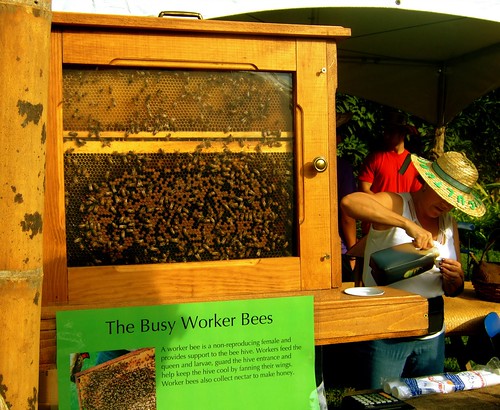
Currently, there is a bee stand that demonstrates apiary (beehive) culture. Don't worry -- they're not aggressive and won't come at you and sting. I was worried about them too, but they keep to their hive. Insects are obviously key to pollination, so we have to love these critters and be their friends.

Tip: if you happen to come to Fairchild and do visit the pavilion, keep in mind there is a great video that loops during visiting hours, so you can hear curators Richard Campbell and Noris Ledesma talk about the program. Make sure you stop and listen. And if I happen to be roaming about, feel free to yap with me about the plants!

chocolate bean podThe humble origins of chocolate. This fruit was picked from Fairchild's rainforest during my basic botany class last June. It's the cocoa bean that becomes the tasty stuff we love so much.

Don't forget about the Third Annual Chocolate Festival coming up January 24-25. I've actually never been, so I'm looking forward to it. I'll be volunteering that weekend and am in the process of learning more about the world's most favorite tropical plant -- theobroma cacao. (Well, I'm assuming it's the world's most favorite, since chocolate is practically universal.) We have two of them in the pavilion and one of them in the rainforest. But there are supposed to be many chocolate-related exhibits and vendors in the main lawn. Hope to see you there!

January 5, 2009

Mark Di Suvero Sculptures

Mark di Suvero's sculptures are meant to be interactive. One of them even has a swing. Photo by tiswango.

The art season is nearly in full swing at Fairchild, save for some Botero sculptures that are waiting to be installed and some random Chihuly sculptures that are in permanent exhibition.

This year, the main artist featured is Mark di Suvero, who specializes in enormous steel installations. As a volunteer, I had the opportunity to take a wonderful class about the artist. I really appreciate the opportunity because in learning about the artist and his life I've come to appreciate his work all the more.

Mark di Suvero was born in Shanghai, 1933. He has led a fascinating life, which you can read more about here. Circa 1960, he worked odd jobs in New York City, during which time he suffered a near-death experience that would end up transforming his approach to art.
On March 26, 1960, he arrived with cabinets at a building under construction on 57th street in Manhattan. Since the cabinets were too big for the construction elevator, they placed them on top of the elevator and Mark rode along as the elevator operator managed the controls. The operator made a mistake, and Mark was crushed and was pinned under 2,000 pounds of weight for an excruciating hour while he was still awake. Many bones in his body were broken, including his back. He was paralyzed from the waist down. He spent two years in hospitals and rehabilitation facilities, and gradually regained some use of his legs. Most of his remaining life would be spent in a wheelchair.
From class booklet

Does this sound familiar? Painter Frida Kahlo also suffered a near-death accident and survived to paint nothing short of glorious. When you know this man's history, it is amazing to see these unwieldy, heavy and enormous scupltures gracing the expansive Lowlands (east section of the garden). There is no way you can't think of the enormous weight of these things. I'm still perplexed as to how steel was easier to work with than wood, but so it is.

It's also interesting that Mark di Suvero was so inspired by urban New York -- the last place you would associate with Fairchild. It's surreal to see large steel lines and diagonals in a very tropical, organic surrounding. The sculptures remind me more of the skeleton of skyscrapers, rather than the soft silhouettes of bamboo and palm fronds.

Yet we have to remember that the garden -- which appears like it has been growing its particular way forever -- was completely orchestrated by architect William Lyman Phillips 70 years ago, around the same time he designed Matheson Hammock Park next door (Miami-Dade county's first park). As a matter of fact, Fairchild is partly owned by Miami-Dade county, because its founder, Colonel Montgomery did a smart thing: he deeded part of the land so that the Works Progress Administration workers from the park could also work in the garden. And there was a lot to do: the original design worked around a significant limestone elevation, which you can clearly see in the main overlook by the arboretum.

So think about all this when you see the the juxtaposition of these steel sculptures against the plants and the sky. A botanic garden is not only there for scientific purposes (conservation and study) but also to tempt the eye and stimulate the mind. It is never a random collection of plants, but a well thought-out living museum of plants and art.

Thursday nights at Fairchild has already started. It's a great (and very romantic!) time to come see the art work in the twilight. If you go at night, let your nose pay attention to all the night-blooming flowers in the garden (and if you kiss your beloved, I won't tell!). If you go during the day, also check out the Keys Coastal Habitat trail and the scrub pine trail down in the Lowlands.

The art work will be on display until May 31st.


December 22, 2008

Keys Coastal Habitat


I volunteered on Saturday but yesterday I just went to hang out and explore. I walked down to the Keys Coastal Habitat, which is in the southeast section of the garden known as the lowlands.
The habitat, with existing marsh and mangroves, was planted with Florida native species, principally those from the Florida Keys, that are attractive to birds throughout the year, but with a special emphasis on migrant species.
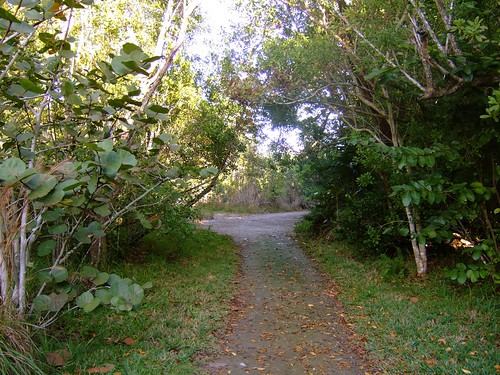
In the Keys Coastal Habitat, you'll find a winding trail and a wilderness within easy access of urban Miami -- a great respite from the city. Though there are residential backyards literally next door, it's a very peaceful place.

The habitat is a great way to see what the original Florida might've looked like. Existing vegetation was enhanced with other species that thrive in this kind of ecosystem. The trail is full of labels and tags on many trees and shrubs. If you're interested in learning about native gardening, this is a great resource.

Yesterday, I did not actually see any birds -- the only wildlife I saw was a squirrel! I also thought I heard something growl, but you know me, I have an overactive imagination. I also ran into a big cobweb and did a little cursing.

I am told though that with patience you will find a lot of birds here. There are a few posts in the lowlands for raptor nests, but those are currently empty.

If you come to visit this part of the garden, be prepared for a long, lovely walk. The trail begins at the end of the coconut grove, which you'll find by the lake (there is a tiki hut and bench at the grove's entrance).

I recommend you bring comfortable shoes. The best time of the year to visit the trail is during the cooler months when there are fewer mosquitoes. (I actually did not get bit once during my tour.) The trail is not paved but very worn and clear, with several connected detours. Also, unlike Matheson Hammock's mangrove trail, this one is pretty much above water level so I don't think it would get flooded during high tide, though the trail felt moist under my sneakers.

I live streamed from my phone. Click the play button below if you want to join me during part of my exploration; it's about 12 minutes long.

December 21, 2008

Ay Caramba!


Ay Caramba!, originally uploaded by vicequeenmaria.

Do you remember the carambola (starfruit) espalier I've been tending for several weeks? Well guess what? Yesterday, I was looking for the flowers and what did I find?

The fruit of my labor!

Though not yet ripe, don't they look absolutely luscious?

Miscellany - December 21

Here is some miscellany I wanted to share with you ...

BLOG

I likE plants! is a very cool blog by Tamarac resident Eric Bronson, who describes himself as:
I'm an amateur grower of Tropical Fruits, Species Orchids, Aroids, Bamboo, Rare Palms and other unusual tropical plants. I'm located in Zone: 10b, Lat/Lon: 26.25N 80.26W My garden is completely organic. I am also a member of Fairchild Tropical Botanic Garden, The Rare Fruit & Vegetable Council of Broward County and the American Orchid Society. All the photos you see here are of my yard (unless otherwise noted) and were taken with a Kodak EasyShare M853 Zoom.
Eric also has a Flickr stream and a Rare Tropical Fruits Flickr group.

FLORIDA ADVENTURES

Do you remember the ghost orchid? Well, don't miss Prem Subrahmanyam's amazing photo gallery. Prem has a gorgeous website detailing his nature expeditions in writing and photography.

LOCAL ORGANIC AGRICULTURE

The best thing about growing things: eating them! Paradise Farms is a must see:
Paradise Farms is a beautiful five acre certified organic farm located in tropical south Florida. We work in harmony with nature to grow the finest quality delicious greens, micro-greens, herbs, edible flowers, fruits and vegetables available to the best chefs in the Miami area.
And, if you're really into it, become a member of Gabriele's Gardening Angels:
Gabriele’s Gardening Angels is an informal network of South Florida gardeners who have expressed a willingness to contribute some of their time and energy to promote the concept and benefits of home based sustainable agriculture to their friends and neighbors.
I'm happy to include all these sites on the sidebar. Happy gardening, everyone!

December 20, 2008

Pomegranate


Pomegranate, originally uploaded by vicequeenmaria.

Pomegranates can be found in local supermarkets now. Have you enjoyed one yet?


These are growing in the orchard at Fairchild. It's a long bush under the tamarind tree, right in front of the aloes. Although I haven't seen a any fruit grow large to edible size yet, the orange flowers are beautiful. The transformation from delicate flower to hardy fruit is always amazing to observe.

December 7, 2008

Tour of the Fruit Pavilion

I don't typically volunteer on Saturdays, but I went yesterday to help out with the Williams Grove fruit market at Fairchild.

I took some minutes to give you a tour of the fruit area. Check it out.


November 23, 2008

Serenity


Serenity, originally uploaded by vicequeenmaria.

When I took Fairchild's architecture class (more on that, coming soon), I learned so much about the garden's architect, William Lyman Phillips. Did you know, he also designed Matheson Hammock, Miami-Dade county's first official park? You don't really think of parks as places you "design" but just look at this photo. There is a vista, beyond the atoll, of eternity. He must've known that when he designed the enclosed pool with the palm trees in the background.

Actually the row of palms in between Fairchild and Matheson (they are adjacent properties) are supposed to tie in the entire landscape in this area of Biscayne Bay.

Matheson Hammock is a very special Miami place that everyone can enjoy. Can you believe that on the other side of this photo is the Miami skyline? It's really an urban oasis.

Living Poetry of Plants

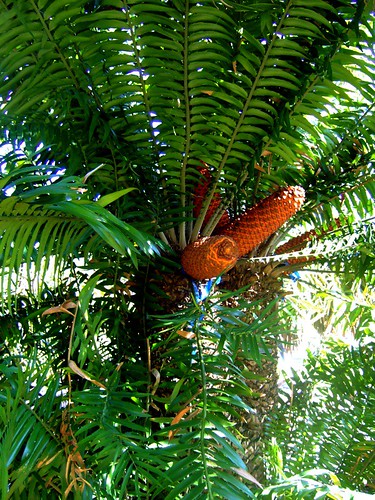
cycad Encephalartos gratus Zamiaceae, female, collected from Malawi, on the property of the Center for Tropical Plant Research. Cycads are really fascinating ancient plants, related to conifers.

On Friday morning, my spirit shifted into a beautiful place by the simple observation of plants and the tenaciousness of life.

Surrounded by cycads, the world’s most ancient plants, right here, practically in my own back yard, was the incredible feeling of “I am complete somehow.” I could taste the salt air of Biscayne Bay on my skin and the fact that the predecessors of these plants had been around for millions of years.

Can you imagine breathing in that incredible air? Filling your lungs not only with oxygen but some living poetry? We have it down here, in Florida for sure – ancient creatures, like crocodiles and cycads. Once you tune into that cycle of nature, the breathing of the tides in the bay, the musky scent of mangroves in low tide, the lilac sunsets -- you have a real, primeval Florida that can inspire you beyond that concrete jungle and expressway tangle.

And which makes me think, this is no shallow place at all, but a place so deep -- even though you can barely dig 15 feet beneath the limestone to find water – but in spite of that you can dig and dig and never really find that treasure of El Dorado.

For me treasure is not gold, but love. And I guess plants bring me closer to this pure energy, more than anything else ever has -- total unconditional love -- love that is just present and beyond the ego.

Maybe we are all in our own little ways a little bit like Ponce de Leon looking in Florida for some fountain of youth, but maybe we should be looking for a fountain of love.

These cycads are not native to South Florida. They came here as the result of exploration and planted at the behest of Colonel Montgomery, the founder of Fairchild. Exploration is at the bottom of all this -- Fairchild was the Indiana Jones of tropical plants. Now, I can't say for sure which plant is attributed to whom-- but this is besides the point, the point is -- someone went somewhere to bring it here -- and this is precisely the spirit of tropical plant conservation that is still going on today. This passion for the plants, this passion to conserve them from extinction in our crazy world today, is the driving force behind all of this.

But let's forget the historical romance ... let me get back to my moment. Today, these cycads are thriving locally. They have not only made a century’s old journey across continents but also a genetic journey of a million years or more … is that not amazing?

And what's more, why can’t people make the same journey – together?

If I describe what I felt last Friday morning, surrounded by these ancient trees in the chill air of a cold front – I would call it pure and simple love – a love based on compassion. Being surrounded by these ancient trees brought out something in me that compelled me to an analogy, a bigger picture, something beyond me yet part of me: we are so much like plants, going through our cycles, flowering, withering and renewing.

Was it not some kind of love that planted these things in the first place?

And the most moving thing of all among these Jurassic plants was the sense of community … none of them exist in a vacuum. We depend on each other, like it or not, to thrive. We need the same soil, the same pollinators, to survive. Actually, this is a good metaphor for social media – the garden.

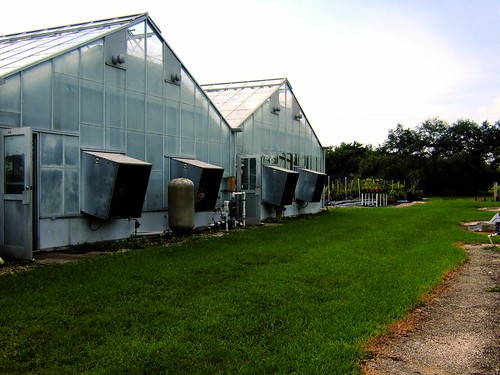
So it was with no surprise that while volunteering back at the nursery -- a greenhouse technologically designed to imitate the environment of a rain forest -- we found a corn snake while repotting a pineapple.

I knew then that this was a kind of Garden of Eden for me, among the slippery mud and muck of the floor, among the humidity, sweat and dirt-soaked fingers of my hands, I had found my own little paradise.

corn snake pineappleOops! This corn snake really didn't want to leave its nice warm, humid pot. You think it's hot and humid in Florida? Those special plants inside the nursery need even more heat and humidty!

FYI ... (sorry, this is the fact-checking journalist in me) Montgomery Botanical Center is located right behind the Center for Tropical Plant Conservation neither of which are open to the public. Mind you, I get to go as a volunteer. As far as I know, both institutions are not currently legally/technically related, though historically it was Colonel Montgomery who founded Fairchild. I know I said I would take a break from writing, and I have ... much catching up to do. But I was so inspired by this moment that I could not help but share and hope it will inspire readers to go to Fairchild, because it is truly something so unique to South Florida and related to the rest of the tropical plant world across the globe.

November 13, 2008

Mary, Mary Quite Contrary ...

Me in the fruit pavilion, as happy as can be. I'm always so happy in this place.

... how does your garden grow?

Some personal issues I have to deal with are keeping me from blogging. I hope to be back very soon with some posts about the wonderful classes I've taken and everything I've learned, not to mention the regular volunteer work I've done at Fairchild recently. There is so much I'm eager to share with you; I've taken volumes of notes and my appreciation for Fairchild and South Florida's gardening community has only grown deeper ... no pun intended!

It really is so truly historically rich ... I'm amazed and love this place all the more.

I just need a wee bit of time off from writing to take care of some things on the home front, but it actually pains me to not have the time/energy to write about something I love so much. I imagine this is how a tree would feel when it can't bear fruit!

Oh well. Patience, right? It's all about growing and seasons ... you see, you learn much about life when you work with plants.

Anyway, that being said, I suppose I don't have to remind readers that now with the nicer weather and all is a beautiful time to start enjoying Fairchild, Old Cutler, Matheson Hammock ...

Please stop by Fairchild's site. It's an excellent resource with info galore. Also, read my friend Doug's post on Old Cutler too. You need to take Old Culter to get to Fairchild. To me this is the most beautiful place in Miami. Hope you can enjoy it too. So much of South Florida history is tied to this special area by the bay.

So while I take my break, make sure you connect to nature in whatever way that is available to you. No harm can be done when we each take time every day to relate to nature, breathe and connect with that grounding energy of plants.

November 1, 2008

Vanilla Orchid


Vanilla Orchid, originally uploaded by vicequeenmaria.

These Vanilla planifolia cuttings from the nursery were transplanted inside the fruit pavilion recently. The vanilla orchid is both terrestial and arboreal; it has roots in the ground and in the air. As you can see, it's climbing exceedingly well inside the warm and humid environment that will hopefully help it produce some seed pods. Right next to these orchids (not pictured here) are two Theobroma cacao trees. Yes, you guessed it: chocolate growing right next to vanilla!

Vanilla is one of my favorite flavors and aromas. To me, it evokes warmth, comfort and sensuality. It's such a common ingredient in so many foods; next time you detect its rich scent, remember it comes from the tropics.

What's your favorite vanilla food or memory?

October 26, 2008

Are You a Chicken When It Comes to Eggs?


Yesterday, I volunteered at Fairchild's first Kitchen Gardening event, which offered a handful of great classes on how to grow your own edibles and enjoy them. (I'll post about the event in detail later next week.)

The chickens from Williams Grove paid Fairchild a visit yesterday. When I left after a long and rainy day, I got to take home a freshly laid egg. I was really excited to try the egg because the only other time I had tried fresh eggs was in Spain, in the rugged Peaks of Europe, where my grandfather was born.

Yet, yesterday, a brief informal survey of a few family members revealed that they are squeamish about eating fresh eggs. My mother said: "I feel sorry for the chicken. I could never eat it."

What the ... ?

Now, I can't for the life of me figure out why on earth an omnivore that doesn't think twice about buying a carton of eggs from Publix would feel sorry for a chicken that lives the life o' Riley down in Homestead. I met those chickens personally. They're allowed to roam the farm and enjoy a deluxe coop where to lay eggs and rest at night. Why cringe and say "ew" to fresh and organic?

So I'd love to know: would you feel weird about eating fresh eggs? Please comment if you have a moment.

PS ... I haven't tried the egg yet. It's waiting in the fridge.