Showing posts with label video. Show all posts

March 18, 2009

Orchid Festival 2009

orchid festival fairchildA spectacular, cascading dendrobrium.

Unfortunately, something went wrong with my "good" camera and so I only have a couple of crappy photos from my mobile phone. But let me tell you -- the Orchid Festival at Fairchild, as always, was a feast for the eyes. Dozens upon dozens of vendors, lined up on the westernmost stretch of the garden, were selling blooms as small as a dime or as big as a dinner plate.

The real treat was the orchid exhibit indoors at the Garden House. Imagine an Oscars ceremony with the A-list stars showing off their hot bods, gowns and baubles on the red carpet. Well, at the festival, these prize-winning blooms stole the show. My friend commented that the orchids were so gorgeous, they almost didn't look real! And it was true -- festooned with their award ribbons, these orchids would've have upstaged even the biggest Hollywood diva.

orchid festival fairchildA prize-winning cattleya.

There's a reason for all this pageantry, of course, and it's all in the name of sex. Each orchid is especially adapted to attract particular pollinators according to shape, scent and color. The variety is daunting. From tiny to titanic, unassuming to gaudy -- each orchid seems to have its own personality for the sake of adaptation.

The festival is a wonderful way to introduce yourself to the world of orchids, even if you have no experience growing them. Fairchild offered classes all day Saturday and vendors were eagerly answering questions.

I'll paraphrase what's said in one my orchid books -- they aren't impossible to grow, and as a matter of fact, can be downright easy, compared to other plants. There's no need to be intimidated. You can, however, make the whole process as complicated as you like.

On the one hand, there are amazing orchids growing off trees with little, if any, human involvement whatsoever. They live off the air and when not in bloom, they look like plain leaves or dead twigs. For example, here's an enormous one that blooms yearly in South Miami:

This orchid blooms in someone's yard every year in a low-maintenance manner. Near the intersection of SW 80th street and 57th avenue.

On the other hand, if you're a hardcore enthusiast, you can spend every day of your life caring for your orchids, working with exotic varieties and hybrids, attending orchid society meetings, reading books and so on. For some, it's a full-time hobby.

Either way, novice or professional, you can enjoy growing orchids here in South Florida as we are blessed with optimal weather patterns and specific pollinators for certain kinds of orchids. They don't bloom as often as other flowering plants but when they do, it's a special treat. To get started, visit the South Florida Orchid Society and the American Orchid Society, which has a great beginner's FAQ.

The festival wasn't all about orchids. Musicians played on the main lawn, food vendors served up some great options -- including traditional Bahamian and Jamaican fare. There were also plenty of activities for kids.

I had volunteered all day Saturday at the fruit pavilion, cleaning up leaves, making smoothies, assisting with fruit tastings and talking to people about the garden. We were quite busy so I barely got to see any orchids on that day!

It was a great pleasure to attend as a "visitor" on Sunday with a friend who hadn't been to the garden in 20 years. Steve Roitstein of PALO! is not only a great musician but also an avid gardener. He got to take a "Maria" tour, which we finished off at Matheson Hammock Park, enjoying the bay breezes and great view of the Miami skyline just before sunset.

Thankfully, I was able to get a video on Qik of the prize-winning orchids, but use your imagination. My camera can barely do these beauties any justice!

December 22, 2008

Keys Coastal Habitat


I volunteered on Saturday but yesterday I just went to hang out and explore. I walked down to the Keys Coastal Habitat, which is in the southeast section of the garden known as the lowlands.
The habitat, with existing marsh and mangroves, was planted with Florida native species, principally those from the Florida Keys, that are attractive to birds throughout the year, but with a special emphasis on migrant species.
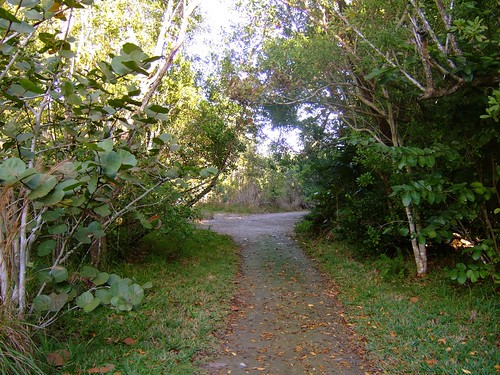
In the Keys Coastal Habitat, you'll find a winding trail and a wilderness within easy access of urban Miami -- a great respite from the city. Though there are residential backyards literally next door, it's a very peaceful place.

The habitat is a great way to see what the original Florida might've looked like. Existing vegetation was enhanced with other species that thrive in this kind of ecosystem. The trail is full of labels and tags on many trees and shrubs. If you're interested in learning about native gardening, this is a great resource.

Yesterday, I did not actually see any birds -- the only wildlife I saw was a squirrel! I also thought I heard something growl, but you know me, I have an overactive imagination. I also ran into a big cobweb and did a little cursing.

I am told though that with patience you will find a lot of birds here. There are a few posts in the lowlands for raptor nests, but those are currently empty.

If you come to visit this part of the garden, be prepared for a long, lovely walk. The trail begins at the end of the coconut grove, which you'll find by the lake (there is a tiki hut and bench at the grove's entrance).

I recommend you bring comfortable shoes. The best time of the year to visit the trail is during the cooler months when there are fewer mosquitoes. (I actually did not get bit once during my tour.) The trail is not paved but very worn and clear, with several connected detours. Also, unlike Matheson Hammock's mangrove trail, this one is pretty much above water level so I don't think it would get flooded during high tide, though the trail felt moist under my sneakers.

I live streamed from my phone. Click the play button below if you want to join me during part of my exploration; it's about 12 minutes long.

December 7, 2008

Tour of the Fruit Pavilion

I don't typically volunteer on Saturdays, but I went yesterday to help out with the Williams Grove fruit market at Fairchild.

I took some minutes to give you a tour of the fruit area. Check it out.


August 14, 2008

Reclamation Project

The Reclamation Project at the Miami Science Museum is a participatory eco-art project developed by Miami artist Xavier Cortada to help restore native habitats for plants and animals across our community.

Planting mangrove seedlings.

The Reclamation Project is the beautiful brainchild of Xavier Cortada, a Miami-based artist devoted to environmental causes. Xavier is an dear old friend of mine; I've known him since my undergrad college days, when he was in law school at UM.

If you've driven in downtown Miami, you've seen some of Xavier's artwork painted on the columns in the underpasses. The strange-looking creatures are actually his interpretation of mangrove seedlings.

Last year, I volunteered with the Reclamation Project and it was a very rewarding experience. A group of adults and schoolchildren helped Xavier plant some mangrove seeds in a protected area of Key Biscayne's Crandon Park. Knowing that each mangrove seed has the potential to flourish and become natural habitat makes the task a very powerful gesture. Xavier told me that he had fond memories of walking around that area with his father when he was a child. His passion and real love for the environment is readily apparent even in simple conversation. I love that he has taken nature to an art form; reclaiming the environment gives everyone a chance to leave a mark on the canvas of the earth.

Helping restore the environment is Xavier's way of giving to the community. In a county where urban development boundaries are a joke, Xavier's project is all the more important.

If you've lived on Miami Beach, you know what I'm talking about. Actually, now that I'm living in South Miami, Miami Beach seems like a concrete jungle to me. It's so congested with high-rises, you hardly know you're on an island. Compared to South Miami and the Everglades, Miami Beach doesn't even feel tropical anymore! That's just incredible, isn't it? On those barrier islands that were sweeped clean of natural vegetation, there remains (as far as I know) only one mangrove area that wasn't replaced by a sea wall -- the border of Indian Creek and Pinetree Park.

On August 24th, Reclamation Project will be collecting mangrove seedlings at Bear Cut. And in September, we'll plant 1100 seedlings at Virginia Key. If you want to get to know the real Florida up close and personal, this is a great way to do it. Visit Reclamation Project to learn more. If you don't want to get down and dirty, you could also contribute by adopting a mangrove seedling for $25. This part of the project is in collaboration with Miami's Museum of Science. Xavier has also collaborated with the museum on the Native Flags project, which is an urban reforestation effort in South Florida.

Xavier has pursued other singular opportunities to do environmentally-conscious art work on an international scale. He has been to both the North and South pole! I joked with him that he was probably the first hot-blooded Cuban to set foot at Antarctica's McMurdo station and would probably contribute to global warming. All kidding, of course! Xavier created some "ice paintings" that I had a chance to see last year at a Wynwood exhibit. He "painted" with ancient ice -- it's really groovy stuff.

ADDITIONAL INFO

No, it's not a cocktail!

You may have seen mangrove seedlings on display at South Beach storefronts. I wrote an article about Xavier's project at Miami Beach 411 in '06 that explains it all.

You can also see mangrove habitats at Fairchild in the "wetlands" area of the garden. Expect to see some iguanas, too!

In the spirit of Nature Girl, I continued my passion for trekking in the muck yesterday at Matheson Hammock park. Below is another video I shot on my cellphone.

July 29, 2008

Mangrove Love

Some of you may have figured out that my alter-ego is Manola. Yeah, that's the penname of a wily wordsmith who loves fishing and all things natural about Florida. Yesterday, I went traipsing through the mangroves during mid-tide at Matheson Hammock Park. I shot this video with my cellphone.


A friend of mine told me that I reminded him of Honey Santana in Carl Hiassen's novel Nature Girl and even though I wasn't kayaking in the Ten Thousand Islands, I was bitten by quite a few mosquitoes during this impromptu adventure. (Nature Girl is a splendid, funny novel written by Carl Hiaasen, which my fellow writer Matt Meltzer just reviewed over at 411.)

Matheson Hammock is a Miami-Dade county park located right next to Fairchild. It has beachfront, mangrove and hardwood hammock environments. After 4:30 pm (wink, wink) you can drive straight through to the end -- where Biscayne Bay meets land's end -- without paying admission.

So there are no excuses! Get your butt out there to enjoy the heat -- bugs and all. There's nothing like being bitten by the real Florida bug: the one that makes you fall in love with this place!

If you are interested in learning more about mangroves, stop by my friend Xavier Cortada's Reclamation Project.

July 27, 2008

Butterfly Days

butterfly days Identification signs were placed all over the garden.

update Aug 4: a new Miami Blue butterfly photo added below, courtesy of Jaret C. Daniels.

I didn't volunteer this week because Jon-Mario was going to be out on Friday and my car had to go to the shop. But I did stop by for a few hours on Saturday to see what I could learn during Butterfly Days, a two-day event dedicated to these beautiful creatures and the gardening that supports them.

I really don't know a heck of a lot about butterflies, but it seems like for those who are into it, there's quite a bit to learn. Many years ago, I lived in a cottage with a beautiful garden. I planted a passion flower vine that promptly became the nourishment of many caterpillars. I observed the process from beginning to end -- as they gobbled up the plant and then formed a chrysalis. One morning, all of the butterflies had burst out and were flying around me. It was a very special moment and one I'll not soon forget.

butterfly daysIf caterpillars were teenagers, they'd raid the fridge and eat you out of house and home!

I caught two lectures on Saturday. If there's one thing I learned, it's that butterfly gardening requires balance. If you simply want to attract adult butterflies, plant nectar host plants so that they can feed. But if you want to support the entire lifecycle, also plant larval hosts so that females can lay eggs and caterpillars can eat. Maintaining the right number of plants seems to be the key ... and part of the fun!

milkweedMilkweed is a butterfly favorite.

BUTTERFLY GARDEN BASICS

Cindy David, a very entertaining and enthusiastic lecturer from the Florida Chapter of North American Butterfly Association, talked about Butterfly Gardens 101. She said something that stuck in my mind: "Butterflies are flying flowers." I had never thought of them that way, but it's true -- their delicate wings are like moving petals.

Here are some of Cindy's recommendations for host plants to attract many different kinds of butterflies:
  • monarch and queen - milkweed
  • julia, fritillary and zebra - passion vine varieties (passiflora), including Florida native, Corky Stem (passiflora suberosa)
  • atala - coontie
  • sulphur - cassia and senna
  • east black swallowtail - dill, parsley and fennel
  • swallowtail - wild lime (as a substitute for citrus)
Monarchs and queen caterpillars feed on pretty but poisonous milkweed. For this reason, birds will not eat the caterpillars, which means you'll always need plenty of milkweed for their food supply. On the other hand, you'll also have an abundance of butterflies.

Again, it's all about balance.

And speaking of, the great thing about butterfly gardening is that it requires the use of native plants, which means your garden can support the local ecosystem. Some of the plants, like Firebush (hamelia patens), also attract hummingbirds to their nectar and other avian species to their seeds. You can learn more about gardening with native plants from the Dade Chapter of the Florida Native Plant Society.

THE MIAMI BLUE

Miami Blue, Hemiargus thomasi, basking on twig (dorsal view of male) Photo by David L LysingerPhoto by David L Lysinger, courtesy of Miami Blue Chapter

My favorite part of Butterfly Days was learning about a rare and fascinating little creature -- no bigger than a nickel -- called the Miami Blue. This native Florida butterfly used to thrive on the east and west coasts of Florida, as well as the Keys and the Dry Tortugas. Urban development and mosquito spraying, as well as the devastating impact of Hurricane Andrew in 1992, led to declining populations. At one point, many scientists believed the Miami Blue was extinct. It wasn't until 1999 that a butterfly enthusiast spotted Miami Blue at Bahia Honda State Park.

Jaret C. Daniels, Ph.D. of the University of Florida gave a lecture about the Miami Blue. Jaret is an Assistant Professor of Entomology and Nematology at the university's Institute of Food and Agricultural Sciences. He also leads a Miami Blue captive propagation program at the McGuire Center for Lepidoptera Research in Gainesville.

miami blue butterflyA female Miami Blue is not as blue as her male counterpart. What distinguishes Miami Blue from similar butterflies is the white band underneath the black and blue spots. Photo courtesy of Jaret C. Daniels.

Here are some notes from the lecture:
  • The Miami Blue population at Bahia Honda likes living near the beach and it feeds on Gray Nickerbean (Caesalpinia bonduc).
  • Miami Blue larvae have a symbiotic relationship with ants. Larvae secrete a sugary substance from special organs on their backs, which ants consume. In return, ants protect larvae from predators and parasites.
  • Hurricane Andrew had a devastating impact on the already declining population of Miami Blues. The hurricane season of '05 also affected populations. The loss of coastal habitat during a storm is the main culprit.
  • The captive propagation program has produced over 30,000 viable organisms since 2003. A Q-tip, soaked in Gatorade as a substitute for nectar, feeds the adults. Between 2004-07, about 5,000 butterflies were introduced into the environment.
  • In 2006, a population of Miami Blues was discovered at Boca Grande Key (Key West National Wildlife Refuge).
  • The best place to spot the Miami Blue and many other butterflies is Bahia Honda State Park.
Despite efforts at conservation, Miami Blue's comeback has been modest. It's still not out of danger. If you want to learn more about Miami Blue and other butterflies, visit The Miami Blue Chapter of the North American Butterfly Association.

TOUR THE GARDEN

Here is an impromptu video I shot on my cellphone of the butterfly garden this weekend. Enjoy! Click through to YouTube so you can see the video in high-quality mode and also read my annotations.

July 12, 2008

Mango Peeling and Cutting

champagne mango
In preparation for the mango festival, about a dozen volunteers gathered at the garden early Friday morning to peel and cut about 200 or so mangos. Some of the fruit was to be used for smoothies and some of it for bite-sized samples. Peeling and cutting for smoothies had already been going on in the Redlands at the Williams Grove facility a few weeks prior. Obviously, that fruit was frozen. Over 10,000 visitors were expected for the weekend, so it had to be done.

Peeling and cutting mangos is a very sloppy task, especially with some of the juicier varieties! The best part of the four-hour session, was, of course the opportunity to suck the pulp from the seeds, which is one tastiest experiences a mango lover can enjoy. The "champagne" mango was simply delectable. The scent of mangos filled the classroom building, prompting many staff members to stop by the room with smiles on their faces.

mangos fairchildThis mango wasn't peeled first, but the photo shows good cutting technique.

We didn't have to be too fussy about preparing pulp for smoothies, but the fruit samples had to be cut precisely into square shapes. One of the volunteers had the technique down pat. If you're going to slice mangos at home, here's how to do it. Using a flat-edged knife, slice off the rounded edge of the stem point, then peel the mango. From the sliced-off end, cut some longitudinal lines all the way to the bottom of the mango. Follow with latitudinal lines in the desired size. Then simply slice the squares from as close to the seed as possible. Repeat on the second side and cut any remaining flesh off the edges of the seed.


My friend
Bohopoetgirl was covered in mango! See fruit-slicing technique at the end of the video.