Showing posts with label volunteering. Show all posts

January 14, 2009

Lessons in Volunteering and More ...

tropical fruit smoothies at fairchildFruit smoothies, jams, chutneys, honeys and seasonal fruits sold -- all home grown -- at Fairchild Saturdays and Sundays, open during the "season," typically December through May when the art work is on exhibit.

I can't believe it, but I've been volunteering for just over seven months already! Here's a recap of my feelings about the experience and what I've learned:

The winter season gets busy at Fairchild, what with the art exhibits and all. Not rock-concert crazy busy, mind you -- it's not crowded or uncomfortable -- but as with everything in South Florida around this time, more people are expected to show up.

Williams Grove sets up a smoothie stand during "season" weekends and so I've been asked to help. I actually haven't made many smoothies, but I've helped the guys close shop and have done a little horticultural stuff on the side. My buddies have been: Jon-Mario, whom you all already know as the fruit program manager; Ruben, who works at Williams Grove; and JC, a high school student volunteer who mans the smoothie bar like nobody's business.

But mainly, and quite unexpectedly, I have spent time talking to visitors about tropical fruit, the pavilion and why it's so special, the genetic program as well as the overall garden, its history and architecture. All of the horticultural work I've done, as well as the classes I've taken, have proven invaluable not only in helping me understand and appreciate the garden, but also in explaining it to others. The get-your-hands-dirty work has been great and the classes, equally so -- chock full of information but nothing too heavy.

Over time, the same passion that drew me to the garden in the first place has made it easy for me to talk about it to any random visitor who is willing to listen. Maybe I've also been inspired a little by Dr. Paul George, who is such a great raconteur about the thing he loves so -- the city of Miami. It's no surprise that my interest in Miami's history coincides with volunteering at Fairchild.

Anyway, it has also been wonderful to meet people from all over the world. That's what I've come across with when I've been there on the weekends this season -- tropical plants and international folk.
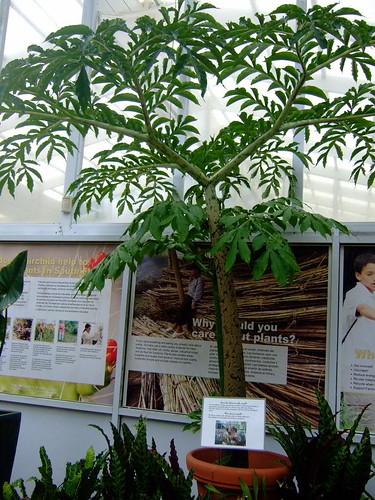
mr. stinkyMr. Stinky isn't part of the fruit program, but these ladies asked me to take them to see the notorious smelly plant. Currently (as you see it above), it's not blooming.

One day, I took three women (two locals and one tourist) over to the conservatory to see Mr. Stinky (Amorphophallus titanum), during which time I answered questions about Fairchild's history and architecture. I was surprised how I just kept blabbing about it, but there you go. They asked me: "Aw come one, why don't you just spend the rest of the day walking around the garden with us?" But of course, volunteer duties called. I felt honored and for this I am thankful.

Another day, I -- along with Ruben from Williams Grove -- inspired a couple to buy a mango tree to plant in their home. The mom of two thanked us for encouraging her not to be afraid to try to grow a mango tree.

Yet another day, I walked a few people through the pavilion, explaining each tree and plant grown there.

Last weekend, I spent about half an hour with some kids, explaining what was inside and outside the pavilion. They were really curious about the fruit trees. It was very rewarding to talk the children; I guess that's because I feel like a kid too, filled with wonder, when I'm working with these amazing plants. I don't have kids or get to spend any time with any, but I do enjoy their company. These kids were really curious and I was amazed at their intelligent questions.

I guess my old role as teacher somehow came out. I never thought I would be attracted to an educational role, because I love horticultural work so much for its solitary and meditative nature -- but then again, there you go ... you just never know when one experience will transform you.

After volunteering here long enough, your knowledge of the garden becomes second nature, yet obviously there is always more to learn, and that's what makes it so rewarding. I can't imagine ever being bored here. It's just one of the many wonderful aspects of being part of this community dedicated to tropical plant conservation.

Think about it -- this is a living museum of plants you take care of every time you show up, you are tending to a horticultural legacy left by Fairchild for all of us to enjoy -- so it's no wonder you're going to get excited about sharing your experiences with others.

In fact, a secret pleasure of mine (don't tell anybody!) is to wander a bit around the arboretum even after the garden is closed and the guard is ushering everyone out. It's at this liminal hour when the sun casts a special golden hue on the garden and somewhere, usually, a wedding is taking place. There is love in the air ... and not just of the matrimonial kind. I love knowing that these trees came from some far-away land, even if I don't know which particular ones; I love knowing that I can walk about them, smell the flowers and fully sense the incredible, peaceful yet primeval energy they evoke.

But back to the fruit:

At the smoothie stand, Williams Grove sells mango, papaya, banana and pineapple smoothies, or any combination thereof -- for $3 each. They also sell homemade jams, chutneys, local honey and homegrown fruit. Last week, they had black sapote, canistel, tamarind, papaya and starfruit. I highly recommend the mango chutney; it's divine with roasted chicken or pork. (And it's made by dedicated volunteers, so you know it's going to taste great!)
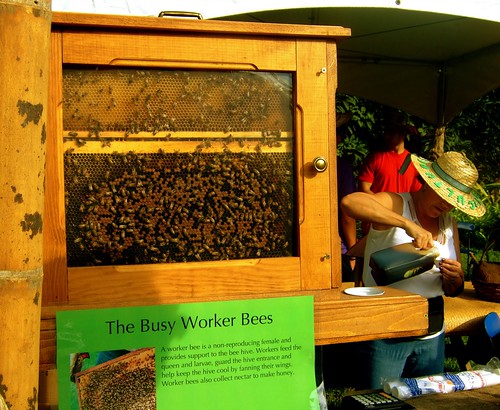
This picture is from the harvest festival last fall, but it's basically the same thing you'll see this season near the smoothie stand.

Currently, there is a bee stand that demonstrates apiary (beehive) culture. Don't worry -- they're not aggressive and won't come at you and sting. I was worried about them too, but they keep to their hive. Insects are obviously key to pollination, so we have to love these critters and be their friends.

Tip: if you happen to come to Fairchild and do visit the pavilion, keep in mind there is a great video that loops during visiting hours, so you can hear curators Richard Campbell and Noris Ledesma talk about the program. Make sure you stop and listen. And if I happen to be roaming about, feel free to yap with me about the plants!

chocolate bean podThe humble origins of chocolate. This fruit was picked from Fairchild's rainforest during my basic botany class last June. It's the cocoa bean that becomes the tasty stuff we love so much.

Don't forget about the Third Annual Chocolate Festival coming up January 24-25. I've actually never been, so I'm looking forward to it. I'll be volunteering that weekend and am in the process of learning more about the world's most favorite tropical plant -- theobroma cacao. (Well, I'm assuming it's the world's most favorite, since chocolate is practically universal.) We have two of them in the pavilion and one of them in the rainforest. But there are supposed to be many chocolate-related exhibits and vendors in the main lawn. Hope to see you there!

November 23, 2008

Living Poetry of Plants

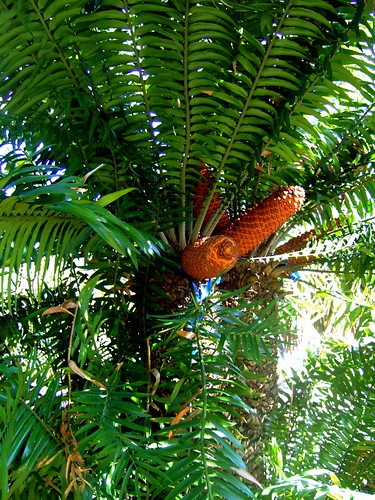
cycad Encephalartos gratus Zamiaceae, female, collected from Malawi, on the property of the Center for Tropical Plant Research. Cycads are really fascinating ancient plants, related to conifers.

On Friday morning, my spirit shifted into a beautiful place by the simple observation of plants and the tenaciousness of life.

Surrounded by cycads, the world’s most ancient plants, right here, practically in my own back yard, was the incredible feeling of “I am complete somehow.” I could taste the salt air of Biscayne Bay on my skin and the fact that the predecessors of these plants had been around for millions of years.

Can you imagine breathing in that incredible air? Filling your lungs not only with oxygen but some living poetry? We have it down here, in Florida for sure – ancient creatures, like crocodiles and cycads. Once you tune into that cycle of nature, the breathing of the tides in the bay, the musky scent of mangroves in low tide, the lilac sunsets -- you have a real, primeval Florida that can inspire you beyond that concrete jungle and expressway tangle.

And which makes me think, this is no shallow place at all, but a place so deep -- even though you can barely dig 15 feet beneath the limestone to find water – but in spite of that you can dig and dig and never really find that treasure of El Dorado.

For me treasure is not gold, but love. And I guess plants bring me closer to this pure energy, more than anything else ever has -- total unconditional love -- love that is just present and beyond the ego.

Maybe we are all in our own little ways a little bit like Ponce de Leon looking in Florida for some fountain of youth, but maybe we should be looking for a fountain of love.

These cycads are not native to South Florida. They came here as the result of exploration and planted at the behest of Colonel Montgomery, the founder of Fairchild. Exploration is at the bottom of all this -- Fairchild was the Indiana Jones of tropical plants. Now, I can't say for sure which plant is attributed to whom-- but this is besides the point, the point is -- someone went somewhere to bring it here -- and this is precisely the spirit of tropical plant conservation that is still going on today. This passion for the plants, this passion to conserve them from extinction in our crazy world today, is the driving force behind all of this.

But let's forget the historical romance ... let me get back to my moment. Today, these cycads are thriving locally. They have not only made a century’s old journey across continents but also a genetic journey of a million years or more … is that not amazing?

And what's more, why can’t people make the same journey – together?

If I describe what I felt last Friday morning, surrounded by these ancient trees in the chill air of a cold front – I would call it pure and simple love – a love based on compassion. Being surrounded by these ancient trees brought out something in me that compelled me to an analogy, a bigger picture, something beyond me yet part of me: we are so much like plants, going through our cycles, flowering, withering and renewing.

Was it not some kind of love that planted these things in the first place?

And the most moving thing of all among these Jurassic plants was the sense of community … none of them exist in a vacuum. We depend on each other, like it or not, to thrive. We need the same soil, the same pollinators, to survive. Actually, this is a good metaphor for social media – the garden.

So it was with no surprise that while volunteering back at the nursery -- a greenhouse technologically designed to imitate the environment of a rain forest -- we found a corn snake while repotting a pineapple.

I knew then that this was a kind of Garden of Eden for me, among the slippery mud and muck of the floor, among the humidity, sweat and dirt-soaked fingers of my hands, I had found my own little paradise.

corn snake pineappleOops! This corn snake really didn't want to leave its nice warm, humid pot. You think it's hot and humid in Florida? Those special plants inside the nursery need even more heat and humidty!

FYI ... (sorry, this is the fact-checking journalist in me) Montgomery Botanical Center is located right behind the Center for Tropical Plant Conservation neither of which are open to the public. Mind you, I get to go as a volunteer. As far as I know, both institutions are not currently legally/technically related, though historically it was Colonel Montgomery who founded Fairchild. I know I said I would take a break from writing, and I have ... much catching up to do. But I was so inspired by this moment that I could not help but share and hope it will inspire readers to go to Fairchild, because it is truly something so unique to South Florida and related to the rest of the tropical plant world across the globe.

October 22, 2008

Volunteering - October 17

williams grove The entrance to Williams Grove. In season, you can buy fruit here on Saturdays.

Last week was a little unusual because instead of working at the fruit pavilion I headed down to the Redlands. I spent the day gathering information for an article about tropical fruit I plan to publish at Miami Beach 411 and came home with an additional bounty of material for this blog, which I will share in the coming weeks.

I spent the first part of the day at Fairchild's agricultural station, Williams Grove -- 20 acres donated by Frank Williams in 2002. About 80% of the grove is commercial and consists of the avocado trees originally planted there by Williams; the remaining percent forms part of Fairchild's living genetic collection, which features mango, mamey americana, jackfruit, canistel, spanish lime, caimito, mamey sapote and avocado. None of these trees are domesticated but rather grew from specimens brought over from other countries in collecting expeditions. The work involved in bringing those specimens to the states is another post in itself!

Noris Ledesma, Curator of Tropical Fruit, gave me a tour of the house and the property, taught me how to graft a tree and gave me a grafted mamey sapote plant to take home. I could really tell how much love and care has gone into the development of this property, much of it done with the help of volunteers.

I also spent time with Senior Curator of Tropical Fruit, Dr. Richard Campbell talking about his background as well as his family's -- he's a second generation Redlands agricultural expert. He also covered the process of running the farm and growing trees. The scientific research done in the fruit program as well as the day-to-day work in maintaining a thriving collection is truly impressive. It takes more than book learning to truly and deeply understand these trees and Richard's passion for the work is readily apparent.

Both Noris and Richard were very welcoming and eager to share. The pair of geese on the farm, however, were not so warm. Every time I walked by, they tried to peck at my feet in unrelenting attack!

Talk about homeland security, this feathery patrol would have nothing to do with me!

The second part of the day I spent at the Fruit and Spice Park with Director Chris Rollins, who gave me a tour. The number and variety of plants there is dizzying! The park is undergoing some expansion now. They're digging a large lake that will feature a waterfall and aquatic plants.

Overall, I left the Redlands with a greater appreciation not only for tropical plants but also for the rich agricultural history right in our own backyard. I definitely plan to spend more time there in the future. It's such a refreshing respite from the city and getting there by way of historic Old Cutler Road makes it even better. Stay tuned for more detailed posts about what this city girl learned in the Redlands that day!

On a side note, Fairchild asked to feature me as volunteer in the next edition of their gorgeous publication, Tropical Garden Magazine. I was very flattered, not to mention honored! I'm not sure when the next edition comes out, but you can browse past editions online here.

October 16, 2008

Volunteering - October 10

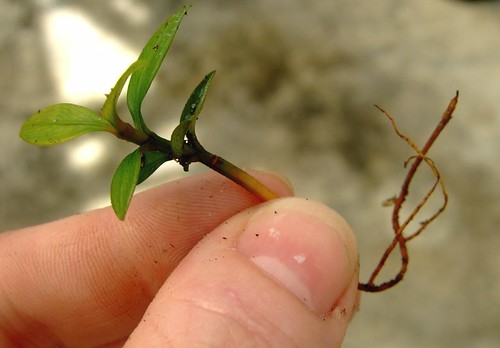
clipping rambutanA cutting of rambutan.

This week we did more pruning, so I don't have much new to report. I continued to work on my carambola.

Toward the end of the morning Jon-Mario decided to do an experiment in propagation. We gathered some cuttings and I took home one from a rambutan tree. If you recall, this particular tree was flowering back in June, but it never produced fruit.

It's not easy for some of these exotics to produce fruit in South Florida. Below and above ground, the Whitman fruit pavilion was designed to mimic the environments where these types of trees normally thrive:
The fruit trees located in the pavilion are indigenous to the acidic soils of the jungles and in order to protect these trees from the alkaline rocky soil of Florida, engineers were required to excavate the area below the pavilion. The acidic soil is maintained by using mulch and water from an acidic cistern. The pavilion must provide both a warm humid environment above and acidic soil below, protecting the rare specimens from root to canopy.
So far, a week has gone by and my cutting is doing doing well, but I don't think it will grow without the specialized soil and environment. Still, it would be very cool to have a tropical fruit tree collection someday. Some trees do grow well outdoors here.

First, of course, I need to get me a house with a yard. Gotta think positive and prosperous! But regardless, I'm very happy to help take care of the trees inside the pavilion.

rambutan clippingA humble cutting of an exotic tree.

The cultural season at Fairchild is picking up with plenty of events, classes and workshops, so there'll be plenty to report here in the weeks to come. Plus, I'm working on a comprehensive article about tropical fruit in South Florida and it includes a report on Williams Grove to share with you! Stay tuned!

October 9, 2008

Volunteering-October 3

pineapple patchThere's a new pineapple patch behind the gazebo.

Last week we continued working on the pineapple patch by mulching and planting. Gonzalo was there to also help out.

My other tasks included removing dead flowers and leaves from the red button ginger and covering new guava fruit with paper bags to keep the bugs away.


red buttong gingerRed button ginger in the morning sunlight.

guavaGuava fruit even at this stage is incredibly fragrant.

I continued to work on the carambola (star fruit) espalier. I was very pleased to see that it is growing flowers all over! I guess the espalier technique really works because in a couple of weeks it went from no flowers to many. The timing is right because according to the Virtual Herbarium, fall is the time for carambola to bear fruit. I'll be so happy to sample it knowing that I helped the trees along in the process.

carambolaCarambola buds before flowering.


carambola Tiny little carambola tree flowers, smaller than the width of my thumb nail!

This isn't the only carambola at Fairchild. There are a couple more trees that were fruiting about a month ago near the big Baobab and the vine garden. Those trees are growing upright though.

More about carambola:
As fall approaches, South Florida's carambola trees hang heavy with golden fruits. The carambola, or star fruit was introduced into Florida over 100 years ago from Southeast Asia. In Florida fruits can be found through the year but the main crop usually matures from late summer to early winter depending on the cultivar.
Carambola is delicious, with a crisp texture and a somewhat tart flavor. I'm definitely going to try out some of these recipes when carambola starts appearing in the markets.


September 30, 2008

Volunteering - September 26

malay appleAn archway of Malay apple.

Last Friday I spent a lot of time pruning like last week -- once again, the noni -- as well as touching up some new growth on the carambola. I also trimmed the lovely archway by the gazebo, which consists of Malay apple.

New pineapple plants, ready for planting.

Afterwards, I cleared up the pineapple patch behind the gazebo. Jon-Mario said we'd be planting new, healthier pineapples soon.

man workingWe finally found a solvent for tape, but still needed a lot of elbow grease!

Another thing we worked on was cleaning the plastic sheets that cover the informative posters in front of the pavilion. The ends had been glued with tape so we tried to figure out what we could use to dissolve it. This was time consuming and Jon-Mario said he would be continuing with the other three posters the following week.

jackfruitA truly tropical feast: coconut, dwarf bananas and jackfruit (Artocarpus heteropyllus).

After our work, Jon-Mario treated a new volunteer and I to some jackfruit from a tree in the garden. If you recall, I posted a photo of the tree back in August, when it was bearing six huge fruits.

It was my first time trying jackfruit and it was really delicious! The fruit is a bulb that lies tucked inside some fibrous strands so it needs to be pulled out. The edible part is soft and not at all fibrous. There's supposed to be a sticky latex around the fruit, but I didn't feel it. The taste is something like mango, but more subtle, with hints of passion fruit and pineapple. (Some people think it tastes like Juicyfruit gum.)

jackfruitDelectable jackfruit ready to eat. The seed is on the inside.

I really enjoyed it and would eat it more often, but it's rare to find it commercially available in South Florida and even when it's sold it runs about $2.50 - $3 a pound, according to Jon-Mario.

The jackfruit tree in the garden is not a really big tree, in spite of the size of the fruit -- though I'm sure the tree is trimmed. If I had a yard, I'd definitely plant jackfruit tree.
This most unusual of fruit is a member of the mulberry family, although its outward appearance would not suggest the relationship. The fruit can weigh upwards of 30 or 40 pounds, with an unusual, spiky green skin. Inside there are a hundred or more large, starchy seeds surrounded by a sweet and aromatic flesh, all attached to a central core.
To learn more about jackfruit, visit Fairchild virtual herbarium.

September 23, 2008

Volunteering - September 15

noni Noni fruit with flower in the background.

Last week was pretty low-key. I finished the project I started September 5th, which was pruning and winding the carambola trees into an espalier. It doesn't seem like a difficult task (it's not) but it does take quite a bit of time. It's amazing how quickly these fruit trees produce new growth!

I also pruned the tops of the noni trees, which are beginning to produce fruit. Jon-Mario told me that the fruit, when it reaches the ripening stage, has a very unpleasant smell.

September 9, 2008

Volunteering - September 5

star fruit carambola vineTraining star fruit (carambola) trees to grow sideways on three levels. You can see the difference between the trained vine on the left and the thick growth on the right.

This week, I started with the usual housekeeping -- picking up leaves and sweeping the path inside the pavilion. But later, I had an interesting task, which was to "train" some starfruit trees to grow sideways, as in a vine. Jon-Mario had cut back the trees just before the Mango Festival in July, but much of it had grown back quite thickly.

Apparenly, there's something about training the branches and twigs and supporting the old growth that helps the starfruit flower and fruit. The task doesn't seem like much, but it's meticulous and took most of my volunteering session that day.

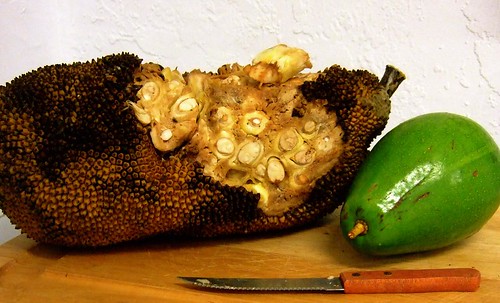
jackfruit and avocadoThis was actually a smallish jackfruit (left).

Jon-Mario had brought a jackfruit for me to try, but it seems like it had been picked too early and had not ripened properly. I didn't want to sample it because I had never tried jackfruit and since Jon-Mario told me it wasn't at its best flavor, I opted to wait until a good one comes along. The inside of the fruit is impressive looking. Its scent was very sweet and reminded me of a cross between pineapple and passion fruit. The avocado, however, I did take home! It became part of a salad with grape tomatoes, chopped onion and cilantro, olive oil, lime and sea salt.

September 3, 2008

Volunteering - August 28

http://farm4.static.flickr.com/3203/2809008489_9478a61f9a.jpgThe potential for abundance: I found this mangosteen seedling while transplanting some other larger plants.

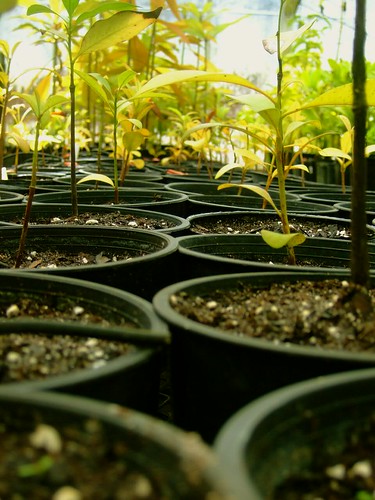
This week we basically finished up what we started the week prior. Gonzalo and I transferred many smaller plants to larger pots, including miracle fruit, durian, jack fruit and mamey. I love working with fruit because it makes me think of the potential for abundance in every seed. It really is an incredible thing -- even though it's something we often take for granted.


http://farm4.static.flickr.com/3203/2809008489_9478a61f9a.jpg Rows of small mamey trees. Jon-Mario's task later that day was to fertilize all the plants we had repotted.

http://farm4.static.flickr.com/3203/2809008489_9478a61f9a.jpgSetting up the drippers on some miracle fruit.

August 25, 2008

Volunteering - August 15

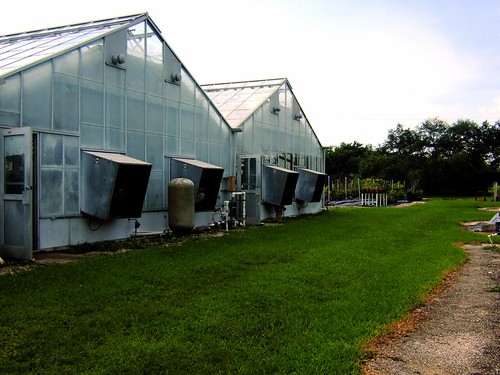
center for tropical plant conservationJust two of several greenhouses at the Center for Tropical Plant Conservation.

This week we had a change of pace from working at the fruit pavilion. We met at the Fairchild grounds at 8:30 am and then drove to the Center for Tropical Plant Conservation (CTPC) to work with plants in the nursery. Located just minutes from the Fairchild grounds, CTPC is where much of the scientific work takes place:
The Center for Tropical Plant Conservation is dedicated to conserving tropical plants, driven by the imperative to avoid the extinction of species and their habitats. These activities are measured by the delivery of quantifiable conservation benefits to Fairchild's priority geographic investment regions (South Florida, Caribbean, oceanic islands, tropical Africa, and Madagascar) and plant groups (palms, cycads, tropical fruit and tropical trees). These have been selected because of conservation need, institutional expertise and history. Main activities include field exploration of important plant areas, conservation assessments, species recovery and direct support to in-situ conservation.
CTPC is unique not only for its mission, but also because it's one of few botanic gardens with a molecular lab, operated in association with Florida International University. As well, CTPC has an extensive herbarium of Florida and Caribbean botany, with over 165,000 specimens, some of which have been posted online in this incredible Virtual Herbarium.

On Friday, we worked inside one of the greenhouses.

center for tropical plant conservationThis particular nursery serves the tropical fruit program. The floor was rather slippery!

center for tropical plant conservationJon-Mario planted each of these healthy young plants back in March from pineapple tops.

Our task included repotting small sapodilla fruit trees to larger containers. Sapodilla is native to the Yucatan and was probably introduced to Florida from the Bahamas in the 1800s.
The sapodilla is found in Florida as far north as Merritt Island, but mostly is found from Miami to Key West. . . . The flavor is like a cocktail combining pear, peach, brown sugar, cinnamon and a little brandy. Sapodilla fruits are soft, sweet and have a beautiful smell when ripe.

From the Tropical Fruit Collection (scroll down)
We had to set up our repotted sapodilla on these long, metal tables that roll side-to-side. Although the nursery has a sprinkler system, we tried to attach a dripper to each plant. The drippers are small hoses lined up on the middle of each table.

center for tropical plant conservationOur work station inside the nursery. That wall against the back is actually a HUGE filter-like metal screen that drips water on a timer.

It was quite humid inside the nursery, but with open doors the air circulated (we're very close to Biscayne Bay here, so there's breezes). After seeing this nursery and working at the Whitman pavilion at the Fairchild grounds, I think I'm getting a better sense of what tropical really means (climate-wise) from a horticultural perspective.

center for tropical plant conservationRepotting the sapodilla. Jon-Mario told me that the plants looked yellow because they had an iron deficiency. I think we're supposed to fertilize them next week to correct that.

center for tropical plant conservationThe sapodilla trees we repotted, ready to grow some more!

August 12, 2008

Volunteering - August 1

richard campbell Dr. Campbell pruning trees inside the fruit pavilion.

I didn't volunteer the past two Fridays because Jon-Mario was taking some time off. Then last week, I strained my shoulder at the gym, so I had to refrain from physical activity for a couple of days.

This past week though, we worked very hard at "spring cleaning" the fruit pavilion. Dr. Richard Campbell, Senior Curator of Tropical Fruit, was pruning many of the trees inside the pavilion and outside in the orchard.

What a mess! Most of the plants were pruned to promote long-term healthier growth.

We filled three truck loads of plant clippings!

Jon-Mario and I also dug soil away from the base of the tree trunks so that their roots could better absorb water. It was a very physically strenuous session, but all worth it, of course!

Some of the trees may have been originally planted too deep. We exposed the surface area around the base of this Langsat tree so that water from the sprinklers can now readily reach its roots.

I had a chance to chat briefly with Noris Ledesma, Tropical Fruit Curator. She told me that they are selling fruit from Williams Grove on Sundays. Don't forget: admission is free on Sundays, August through September.

July 20, 2008

Volunteering - July 18

wheelbarrow I filled up the wheelbarrow with four loads of leaves.

Jon-Mario told me I didn't have to come in this week since we had put in so much time at the Mango Festival, but I went anyway for an hour or so and cleaned up fallen leaves in the pavilion. It's just good to work up a sweat and be surrounded by plants, which is why I always think the plants are doing more for me than I'm doing for them.

I decided to start a series of profiles here on Fairchild staff and volunteers. Jon-Mario was my first interview. Stay tuned!

July 6, 2008

Volunteering - July 3

banana treeWe transplanted this banana tree from the orchard to this spot next to the pavilion. No small feat!

This week was a physically challenging one but we accomplished so much in three hours. First thing in the morning, while I picked up leaves, Gonzalo finished mulching a small section of the pavilion that we had missed last week.

Afterwards, I spent most of the time weeding some very aggressive grass from the pineapple grove in the orchard, which is right next to the pavilion structure. Gonzalo told me they had planted those pineapples just two months ago.


fairchild botanic garden banana treeWhere are the pineapple?

fairchild botanic garden banana treeGonzalo helped me do a little weeding.

fairchild botanic garden banana treePeek-a-boo! I see a weed-free pineapple grove!

Note to self: pineapple plants are very prickly! I didn't feel the jagged edges of the leaves very much while I was weeding, but when I got home I saw scratches all over my right arm. Some pure aloe vera gel helped heal the marks quickly.

While I weeded, Jon-Mario and Gonzalo were figuring out how to move a huge banana tree from one part of the orchard to a spot by the pavilion. I can't believe we moved this tree! Obviously, I did none of the major heavy lifting, but I did help steer the gardening cart and hold part of the trunk.

fairchild botanic garden banana treeThe big tree waiting to be transplanted.

fairchild botanic garden banana treeThe two pups growing out of the root ball are called sword suckers, because a) the shape of the leaves and b) they "suck" nutrition from the parent plant.

fairchild botanic garden banana treeThe tree was more top than bottom heavy. This root ball wasn't particularly big.

fairchild botanic garden banana treeGetting the tree to stand straight and settle into the soil. Maybe I'll eat a banana from this tree some day!

All this work was in preparation for the Mango Festival next week. Our final task also had to do with that event; we drove down to the coconut palm grove in the Lowlands to cut some fronds for a tiki hut. The Lowlands is the eastern part of the park, which lies low near a coastal mangrove habitat.

fairchild botanic garden palm frondsWe were allowed to collect only two fronds per coconut palm.

fairchild botanic garden palm frondsThe fronds will be woven into a roof using this metal canopy as a frame.

June 27, 2008

Volunteering - June 27

100 degrees fahrenheit Whew! It's hot in here!

Today, another volunteer named Gonzalo and I helped Jon mulch inside the fruit pavilion. Gonzalo and Jon filled the wheelbarrows with mulch while I raked and spread it out over the dirt. It was quite physically challenging, especially when when the thermometer hit 100 degrees Fahrenheit ... 100 degrees at 10 am!

Needless to say, I skipped the gym today. I got my workout gardening.

Mulching is important because it helps keep moisture on the ground. (We had to make sure we didn't spread mulch over the ground sprinklers though.) As the leaves and bark decompose, the soil receives extra nutrients. A fresh layer of mulch is also more aesthetically pleasing to the eye. The pavilion grounds now look beautiful and ready for the Mango Festival next month.

By the time we were done, there was an invigorating earthy smell in the pavilion, a wet soil scent with hints of pine.

mulchingGonzalo collecting mulch.


fruit pavilionAll mulched and ready to go! We covered the entire pavilion in about three hours.