October 9, 2008

Volunteering-October 3

pineapple patchThere's a new pineapple patch behind the gazebo.

Last week we continued working on the pineapple patch by mulching and planting. Gonzalo was there to also help out.

My other tasks included removing dead flowers and leaves from the red button ginger and covering new guava fruit with paper bags to keep the bugs away.


red buttong gingerRed button ginger in the morning sunlight.

guavaGuava fruit even at this stage is incredibly fragrant.

I continued to work on the carambola (star fruit) espalier. I was very pleased to see that it is growing flowers all over! I guess the espalier technique really works because in a couple of weeks it went from no flowers to many. The timing is right because according to the Virtual Herbarium, fall is the time for carambola to bear fruit. I'll be so happy to sample it knowing that I helped the trees along in the process.

carambolaCarambola buds before flowering.


carambola Tiny little carambola tree flowers, smaller than the width of my thumb nail!

This isn't the only carambola at Fairchild. There are a couple more trees that were fruiting about a month ago near the big Baobab and the vine garden. Those trees are growing upright though.

More about carambola:
As fall approaches, South Florida's carambola trees hang heavy with golden fruits. The carambola, or star fruit was introduced into Florida over 100 years ago from Southeast Asia. In Florida fruits can be found through the year but the main crop usually matures from late summer to early winter depending on the cultivar.
Carambola is delicious, with a crisp texture and a somewhat tart flavor. I'm definitely going to try out some of these recipes when carambola starts appearing in the markets.


October 5, 2008

Miami River Pocket Park

miami river commission  UM national ghandi dayPlanting trees and shrubs to create a new pocket park along the Miami river.

I used to think of a garden as a private space that requires tending, but since I started volunteering at Fairchild my idea of "garden" has shifted to a greater, collective consciousness. In some ways, now that I don't have a garden of my own (except for the orchids on my balcony!) I feel like more of a gardener than ever.

When I am working with the plants at Fairchild, I feel a very intimate connection to nature and no doubt a sense of ownership. But the greatest return here is that the ownership is shared with others who feel the same passion for the garden. It's a perfect world -- both personal and collective.

There are opportunities out there in the city to get your hands in the dirt and for the benefit of all -- a kind of civic gardening -- even if you don't have time to do this on a regular basis. This is exactly what one group of 40 University of Miami students did on one little section of the Miami River on September 20.

As part of "National Ghandi Day," the students teamed up with the Miami River Commission to create a new riverfront pocket park at a formerly vacant parcel between 1675 NW South River Drive and the Southeast side of the NW 17th Avenue Bridge. They planted eight native trees, donated by Vila and Son, as well as 140 flowering bushes.

As some of you may already know, I recently wrote an article about the Miami River for Miami Beach 411. While researching the project, I learned about the Miami River Greenway, a 10-mile path part of which is still under construction or in development. "Pocket parks" are small green areas on the path in between the larger named parks. I applaud the river commission for its effort in developing a greenway for all to enjoy. Although a greenway is not a garden in the traditional sense, it is everyone's backyard. Amazing things happen when people and plants come together!

A final UM volunteer beautification event will take place on Sunday, October 12 on North River Drive, from NW 3rd Street to NW 6th Avenue from 1-4 PM. You don't have to be a UM student to participate. Please call the Miami River Commission at (305) 644-0544 or email miamiriver@bellsouth.net for more information.

September 30, 2008

Volunteering - September 26

malay appleAn archway of Malay apple.

Last Friday I spent a lot of time pruning like last week -- once again, the noni -- as well as touching up some new growth on the carambola. I also trimmed the lovely archway by the gazebo, which consists of Malay apple.

New pineapple plants, ready for planting.

Afterwards, I cleared up the pineapple patch behind the gazebo. Jon-Mario said we'd be planting new, healthier pineapples soon.

man workingWe finally found a solvent for tape, but still needed a lot of elbow grease!

Another thing we worked on was cleaning the plastic sheets that cover the informative posters in front of the pavilion. The ends had been glued with tape so we tried to figure out what we could use to dissolve it. This was time consuming and Jon-Mario said he would be continuing with the other three posters the following week.

jackfruitA truly tropical feast: coconut, dwarf bananas and jackfruit (Artocarpus heteropyllus).

After our work, Jon-Mario treated a new volunteer and I to some jackfruit from a tree in the garden. If you recall, I posted a photo of the tree back in August, when it was bearing six huge fruits.

It was my first time trying jackfruit and it was really delicious! The fruit is a bulb that lies tucked inside some fibrous strands so it needs to be pulled out. The edible part is soft and not at all fibrous. There's supposed to be a sticky latex around the fruit, but I didn't feel it. The taste is something like mango, but more subtle, with hints of passion fruit and pineapple. (Some people think it tastes like Juicyfruit gum.)

jackfruitDelectable jackfruit ready to eat. The seed is on the inside.

I really enjoyed it and would eat it more often, but it's rare to find it commercially available in South Florida and even when it's sold it runs about $2.50 - $3 a pound, according to Jon-Mario.

The jackfruit tree in the garden is not a really big tree, in spite of the size of the fruit -- though I'm sure the tree is trimmed. If I had a yard, I'd definitely plant jackfruit tree.
This most unusual of fruit is a member of the mulberry family, although its outward appearance would not suggest the relationship. The fruit can weigh upwards of 30 or 40 pounds, with an unusual, spiky green skin. Inside there are a hundred or more large, starchy seeds surrounded by a sweet and aromatic flesh, all attached to a central core.
To learn more about jackfruit, visit Fairchild virtual herbarium.

September 23, 2008

Guava

Guava is currently bearing fruit in the garden. The paper bags protect the fruit.

Volunteering - September 15

noni Noni fruit with flower in the background.

Last week was pretty low-key. I finished the project I started September 5th, which was pruning and winding the carambola trees into an espalier. It doesn't seem like a difficult task (it's not) but it does take quite a bit of time. It's amazing how quickly these fruit trees produce new growth!

I also pruned the tops of the noni trees, which are beginning to produce fruit. Jon-Mario told me that the fruit, when it reaches the ripening stage, has a very unpleasant smell.

September 14, 2008

Flickr Meetup at Fairchild

On September 7th, I met with a group of wonderfully talented photographer friends from Flickr. We spent about three hours in the garden clicking away. We were Miami Fever, Fraggle Red, Lenny Furman, Rober2010, Liz Alonso and of course, yours truly.

Here is a slideshow of photos from the day. Don't forget, there are still two more free Sundays in September to enjoy Fairchild.

September 9, 2008

Langsat


Langsat Fruiting, originally uploaded by vicequeenmaria.

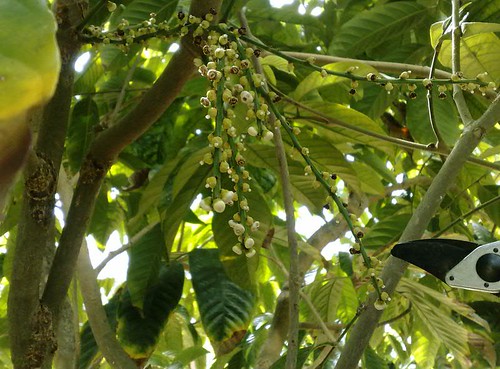
The langsat tree (Lansium domesticum) inside the Whitman pavilion is currently bearing fruit. When I first started volunteering back in June, this is what it looked like:

langsat flower


Volunteering - September 5

star fruit carambola vineTraining star fruit (carambola) trees to grow sideways on three levels. You can see the difference between the trained vine on the left and the thick growth on the right.

This week, I started with the usual housekeeping -- picking up leaves and sweeping the path inside the pavilion. But later, I had an interesting task, which was to "train" some starfruit trees to grow sideways, as in a vine. Jon-Mario had cut back the trees just before the Mango Festival in July, but much of it had grown back quite thickly.

Apparenly, there's something about training the branches and twigs and supporting the old growth that helps the starfruit flower and fruit. The task doesn't seem like much, but it's meticulous and took most of my volunteering session that day.

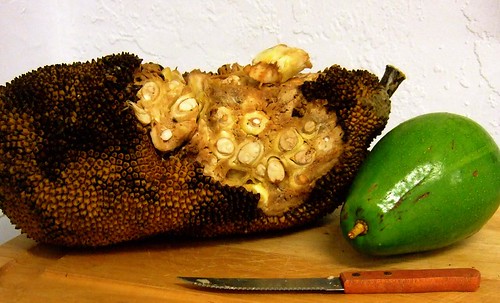
jackfruit and avocadoThis was actually a smallish jackfruit (left).

Jon-Mario had brought a jackfruit for me to try, but it seems like it had been picked too early and had not ripened properly. I didn't want to sample it because I had never tried jackfruit and since Jon-Mario told me it wasn't at its best flavor, I opted to wait until a good one comes along. The inside of the fruit is impressive looking. Its scent was very sweet and reminded me of a cross between pineapple and passion fruit. The avocado, however, I did take home! It became part of a salad with grape tomatoes, chopped onion and cilantro, olive oil, lime and sea salt.

September 3, 2008

Bromeliad Bloom


Bromeliad Bloom, originally uploaded by vicequeenmaria.

Volunteering - August 28

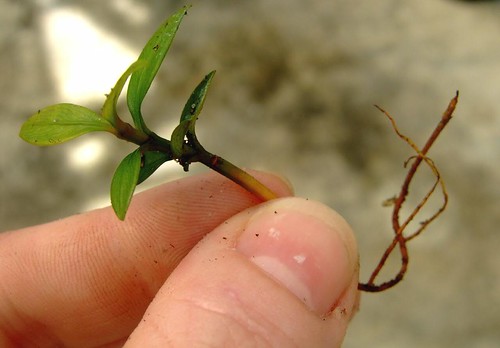
http://farm4.static.flickr.com/3203/2809008489_9478a61f9a.jpgThe potential for abundance: I found this mangosteen seedling while transplanting some other larger plants.

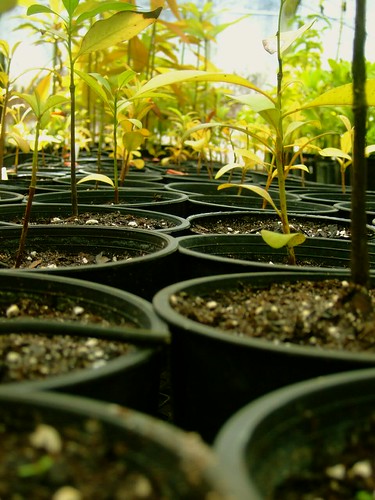
This week we basically finished up what we started the week prior. Gonzalo and I transferred many smaller plants to larger pots, including miracle fruit, durian, jack fruit and mamey. I love working with fruit because it makes me think of the potential for abundance in every seed. It really is an incredible thing -- even though it's something we often take for granted.


http://farm4.static.flickr.com/3203/2809008489_9478a61f9a.jpg Rows of small mamey trees. Jon-Mario's task later that day was to fertilize all the plants we had repotted.

http://farm4.static.flickr.com/3203/2809008489_9478a61f9a.jpgSetting up the drippers on some miracle fruit.